
When I first started building out my portfolio, I had a lot of questions. What’s the difference between B2B and B2C? Should I highlight the product type I’m working on? Reflecting on the projects I worked on, these questions stayed with me for a long time. My journey, though unintentional, eventually led me deep into the world of B2B product design.
Understanding B2B v.s B2C Design
The shift from B2C to B2B taught me a lot about the differences between these two domains. While B2C focuses on engagement and emotional connection, B2B design is primarily about efficiency and workflows. In B2C, the goal often focuses on creating experiences that capture attention and ensure smooth flows for general users. In B2B, the aim is more about solving specific problems for users who are professionals with clearly defined needs.
In B2C, innovation is paramount. Consumers often crave the latest features, meaning continuous product innovation can drive growth and user satisfaction. Conversely, in B2B, stability often takes precedence. Businesses depend on reliable products for their operations and may be hesitant to adopt new features that could disrupt their workflow.
The decision-making process of B2B often involves multiple stakeholders, business goals, and organizational constraints. This dynamic creates unique challenges for designers, as we must balance the user’s needs with broader business objectives.
Becoming a User After Interviews
The question remains: how might we design a new feature without disrupting users’ current workflows?
This is where user research becomes indispensable.
User interviews allow designers to dive deeply into the context of real-world workflows. By listening to users describe their day-to-day tasks, frustrations, and goals, we gain insights into not just what they do but why they do it that way.
Interestingly, these conversations turn abstract personas into solid, relatable individuals. Hearing about users’ daily schedules provides insights into both product innovation and usability.
Once, I worked on a CRM recruiting tool primarily used by account executives and recruiters. Initially, our team had fixed opinions about the product’s functionality and aesthetics, which hindered our ability to innovate effectively. Through interviews, we learned that recruiters needed functionality that prioritized well-organized, accurate data over visual flair.
This insight shifted our focus. Instead of pursuing an entirely new feature set, we improved the product’s basic functions, ensuring it better aligned with recruiters’ day-to-day needs. By understanding their workflows, we could map out a clear path for managing tasks more efficiently.
Navigating Challenges in B2B Design
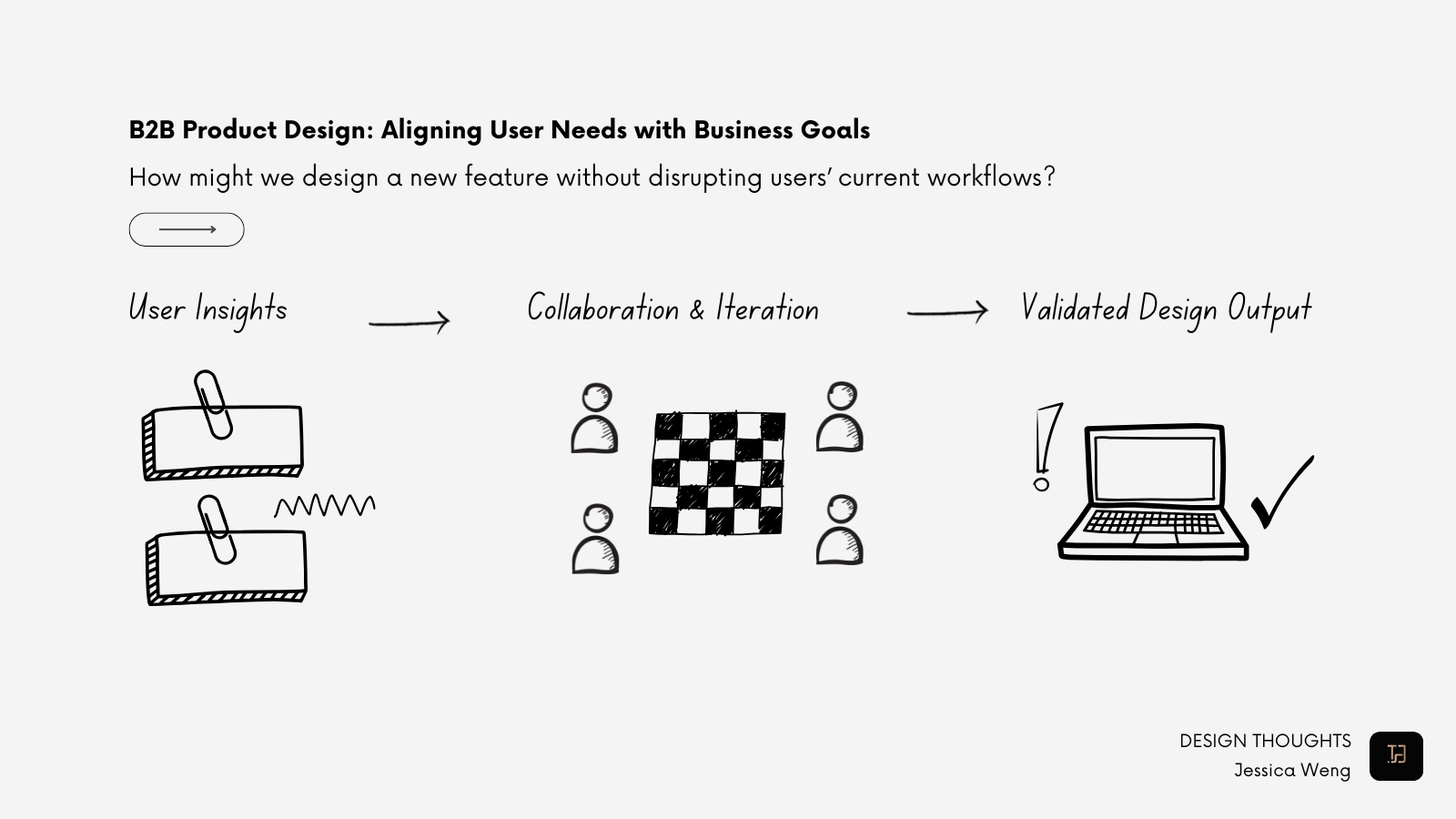
Designing for B2B isn’t without its challenges. Along the way, I’ve learned strategies to address common hurdles and incorporate key lessons for success:
1. Asking the right question.
During user interviews, we sometimes found that the insights diverged from our expectations. For instance, while interviewing recruiters for a CRM tool, the information we initially gathered didn’t fully clarify their workflows. This prompted us to refine our questions and conduct additional interviews, leading to a deeper understanding of their needs. The success of user research depends on asking thoughtful, open-ended questions that reveal users’ true workflows, pain points, and priorities. Superficial or overly directed questions can lead to missing critical insights.
2. Balancing user needs with business goals.
While users may prioritize simplicity and usability, business goals often focus on metrics like revenue, scalability, or compliance. This balance requires collaboration and iteration to align both perspectives. Testing with real users ensures the design meets their needs while addressing organizational objectives.
3. Challenging assumptions.
Preconceived notions from designers, stakeholders, or executives can sometimes steer projects in the wrong direction. Regular testing and validating ideas with research-backed data ensures the product remains on track. As a designer, it’s essential to advocate for evidence-based decisions, even when they challenge higher-level opinions.
4. Navigating diverse stakeholders for design decisions.
In B2B, decisions often involve multiple parties—users, managers, and executives—each with unique priorities. Successfully navigating these dynamics requires clear documentation of requirements and alignment with all stakeholders. Tools like user journey maps or user diaries can help reconcile competing demands by providing a shared understanding of user workflows and goals. This transparency fosters collaboration, especially when shifting business priorities come into play.
Learned from this podcast about how Airbnb’s customer journey map shapes its design path
B2B product design presents a unique set of challenges, but it also offers profound opportunities to create meaningful tools for professionals. By asking the right questions, balancing priorities, challenging assumptions, and engaging with diverse stakeholders, designers can overcome these challenges.
In the end, becoming one of the users isn’t just a metaphor. It’s a mindset that enables us to build products that truly add value, one workflow at a time.

 Tsai-Shiuan Weng