
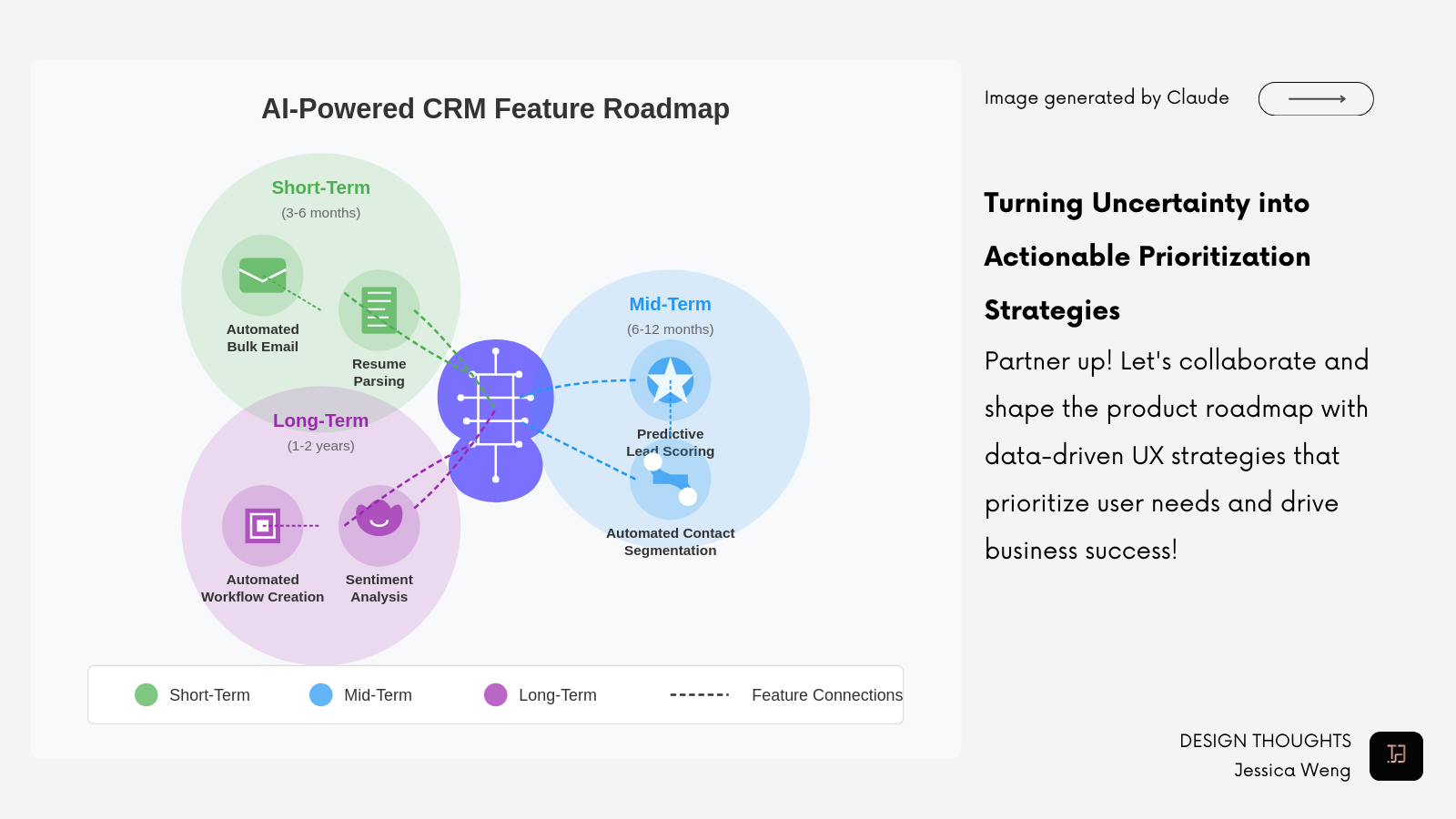
Have you ever struggled with prioritizing the next feature in early-stage product development? When building a product, there’s always ambiguity, shifting priorities, and uncertainty around designs. Discussions and opinions often vary among engineers, decision-makers, and designers, making it challenging to align everyone on a single vision.
The Chaos
A few months ago, I hit a wall leading my first product team. The founder suffocated the design iteration process with constant chanegs. We faced tight deadlines, frequent new requests, ambiguous feedback, and strong stakeholder opinions. It became difficult to maintain focus and ensure practical and efficient progress.
In early-stage product development, uncertainty is constant. Priorities shift, feedback is vague, and decisions often feel like a guessing game. Engineers, designers, and decision-makers all have different opinions on what should come next. Aligning everyone on a single vision felt impossible.
Why a Roadmap is Essential
At some point, I realized we weren’t prioritizing based on user needs—we were prioritizing based on assumptions. We were making decisions reactively, which led to frustration and inefficiency.
That’s when I started thinking about a product roadmap—a shared source of truth to outline our direction, priorities, and progress. A well-structured roadmap helps teams stay aligned, manage stakeholder expectations, and navigate shifting priorities more effectively.
But the next challenge was: How do we create a roadmap that works?
When Priorities Keep Changing
One of the key challenges we identified was the lack of user research. Without a solid understanding of the user’s needs, it was easy to get swayed by internal opinions rather than data-driven insights. To tackle this, we decided to go back to the basics:
- Focus on the Core Problem – Define the core problem you’re trying to solve. It could be a business concept or framed as a How Might We (HMW) question.
- Map Out Problems and Considerations – Identify all possible challenges, misalignment between design and development, and systematically address them one by one.
- Start with Competitor Research – Evaluating features across the industry is important. Understanding how competitors solve similar problems helps in making informed decisions.
Building a Roadmap That Works
With a clearer understanding of our challenges, we started structuring a roadmap. But I quickly realized that not all roadmaps are the same.
Learning from Airbnb, product development isn’t just design work—it involves PMs, engineers, and a holistic design process integrated into a multi-disciplinary team.
In this scenario, I experimented with two key types:
- Feature Roadmap – Defines the scope and focus areas of features, prioritizing MVP-ready features while aligning with the go-to-market strategy.
- Product Design Roadmap – Breaks down what has been designed, what remains to be developed, and how to track iteration progress.
By separating these two, we created better visibility for both designers and engineers. This helped avoid the usual cycle of misalignment—where designs were finalized before engineering feedback or, conversely, where features were built without enough design exploration.
Tracking progress actively became a game-changer. I started identifying misalignments between ideation, design, and development to ensure clear actions and collaboration principles.
UX’s Role in Prioritization
One of my biggest takeaways was that UX isn’t just about user flows—it’s about influencing the roadmap itself.
Before, I thought my role as a designer was just to improve execution. But I realized that designers play a huge role in shaping prioritization by advocating for user feedback early in the process.
Instead of just reacting to business decisions, I started bringing user insights into discussions, influencing how we made product decisions. This shift helped us build not just what the business wanted, but what the users actually needed.
What I Wish I Had Done Differently
Looking back, I wish I had:
- Pushed for user research earlier instead of making assumptions.
- Communicated trade-offs more clearly to stakeholders when priorities shifted.
- Created a roadmap sooner to align the team and avoid unnecessary back-and-forth.
Prioritizing features in an early-stage product is never easy. But by staying focused on real user needs, aligning teams, and having a structured roadmap, I learned how to navigate the uncertainty—and turn chaos into strategy.
What strategies have helped you when dealing with shifting priorities? I’d love to hear your experiences!

 Tsai-Shiuan Weng