
The Loop Space | Extension Space of Architecture
Year: 2018
Category: Academic Project
Type: Architecture Design
Advisor: Ping-Sheng, Wu
My Role: Individual work
Location: Xiaodong Road on the north side of the Department of Architecture, North District, Tainan, Taiwan
Area: 545 m2
BCR: 50%
FAR: 250%
About
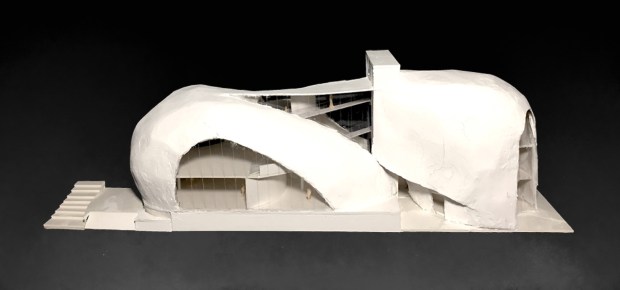
The building served as an exhibition and a wood workshop for the Department of Architecture. Regarding its location, the organic shape corresponded to the important junction and the connection between the old department and the new building. It smoothly fitted in the narrow site and carefully separated the on and off-campus by effectively creating a multiple-layer space. Thus, the project was named “The Loop Space.”
Concept
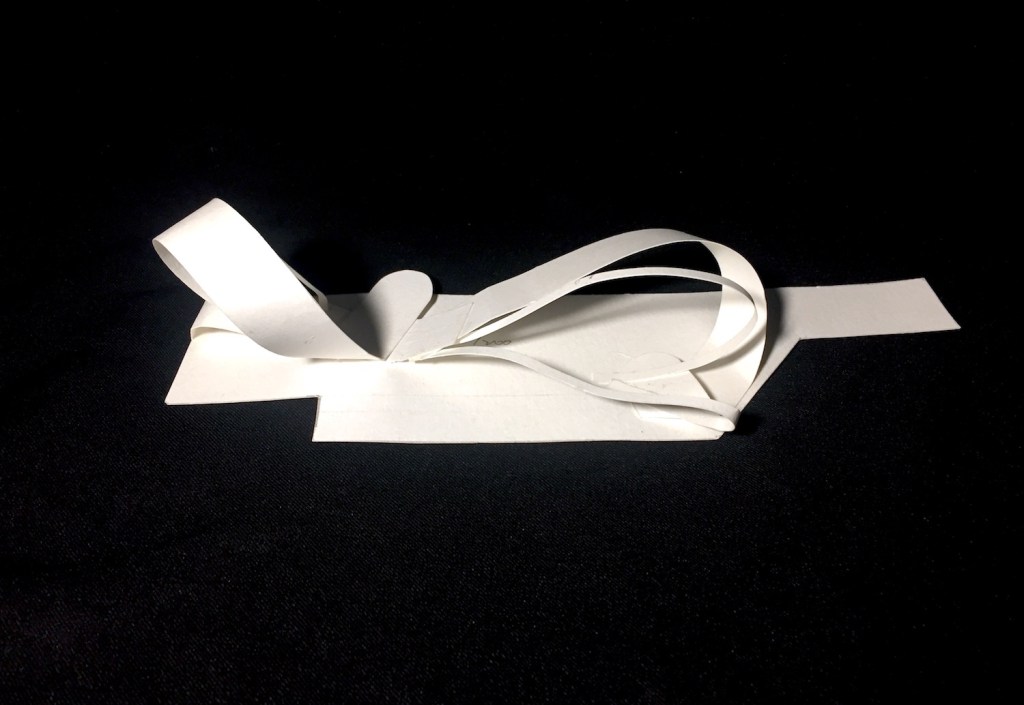
The concept started as a long and flexible slip of paper. I used its curving beauty to get fitting in the narrow site and create several possible spaces to use flexibly.


Problems
Considering the location, there were three major problems:
- While facing the conjunction, the facade of the northwest direction would impact the street view. It might need to be a landmark or completely be integrated into the existed environment.
- How to lead students from their studios to new spaces, in a way following all the original lifestyles in architecture?
- How to separate the public pedestrian and the campus space without copper barriers?

Design Details
In appearance, the organic shape and the white exterior walls contrasted the traditional brick walls of nearby buildings, becoming an exclusive landmark on the intersection. Also, the curving formed effectively separates the campus and the public by its different altitudes.

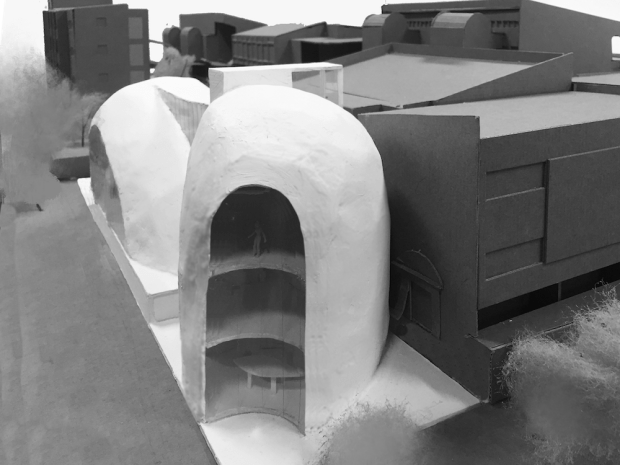
Extending exterior to inside, spaces consisted of several circular floors, connecting by corridors of gentle slopes. There were one major wood workshop and exhibition space on the first floor. The exhibition spaces could be extended to the main presentation space for further activities.

The major activities that occurred could be all the presentation and design lectures during each semester in the architecture department. Therefore, the main presentation room was connected both outside to the open platform and inside to the students’ studios. Every space became visually or physically connected, making multiple layers for random interaction among teachers and students. The spatial relationship showed in the below diagram.

The project combined the unique form and looping spaces for flowability between the original architecture department and the new building. In this way, the building created a way to integrate old and new constructions while increasing the flowability of students’ interaction.


 Tsai-Shiuan Weng